Hook Rate Engineering: The Advanced Guide to Winning the First 3 Seconds (2026)
Your ad is not judged by your video. It is judged by its first 3 seconds. Hook rate is the one number that decides whether the rest of your ad even gets a chance — and in 2026, Meta’s AI scores your hook before you spend a single rupee. This is the advanced guide: the formula, the benchmarks, the psychology, 7 hook formulas, worked calculations, the 3-hook test, real ad examples, and the 5 mistakes that kill it.
1. The formula — what hook rate actually is
Out of 100 people who saw your ad, how many stayed for the first 3 seconds? That is the whole metric.
Find it in Ads Manager: Columns → Customize Columns → search “3-second video plays” and “Impressions”, then divide. There is no single “hook rate” column by default — you build it yourself.
📊 The benchmarks (practitioner guidance, not Meta-published)
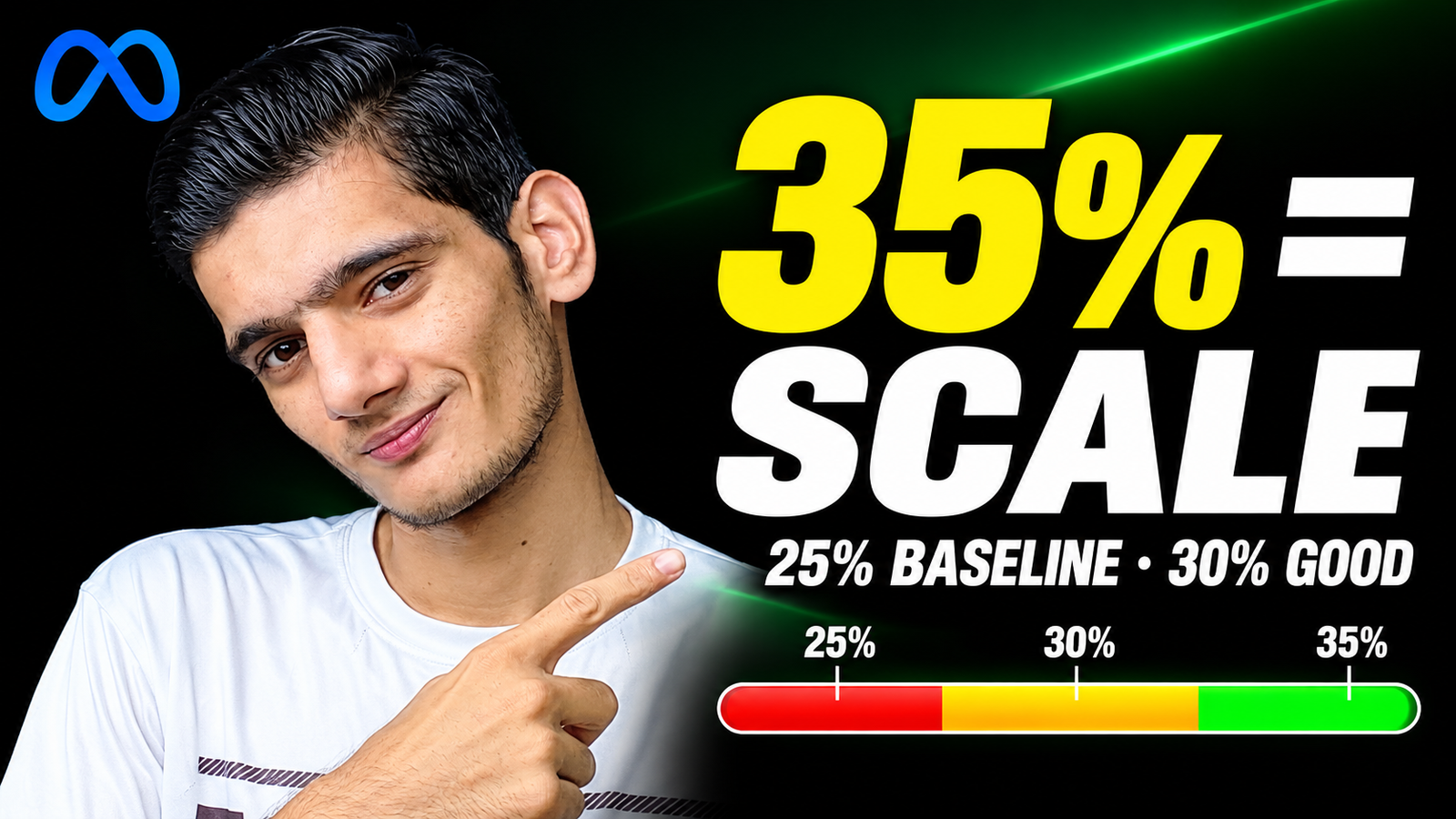
Billo’s average across 88,329 ads (Jan–Jun 2026) was 25.44%. Treat these as working benchmarks from practitioners, not official Meta figures. The thumbnail of this article is the same traffic light: red below 25%, yellow at 30%, green at 35%.
Worked examples — do the maths yourself
| Ad | Impressions | 3-sec plays | Hook rate | Decision |
|---|---|---|---|---|
| Kurti ad A | 5,000 | 1,050 | 21% | Kill |
| Kurti ad B | 10,000 | 2,700 | 27% | Watch |
| Course ad A | 5,000 | 1,600 | 32% | Scale |
| Course ad B | 10,000 | 3,800 | 38% | Scale hard |
Same formula every time: 3-second plays ÷ impressions × 100. A 6-point gap (21% vs 27%) is the difference between a dead ad and a living one — and it is decided in the first 3 seconds, not by the video body.
2. Why 3 seconds decide everything
❌ OLD thinking
“The hook is important — get to the point quickly, then the real video starts.”
✅ NEW reality
“The hook IS the ad. If the first 3 seconds fail, the rest of the video does not exist.”
Attention is the constraint. Global average: 141 minutes per day on social media (DataReportal Digital 2026). Per app, roughly:
And over 60% of Facebook/Instagram time is video. Your ad competes with all of that — in 3 seconds.
Attention span for ads has dropped below 2 seconds — treat it as a 2027 working rule, not a single lab-measured average. The direction is confirmed by the data; the exact number is not.
3. The first-frame test
Before the hook is even heard, it is seen. Pause your ad at 0:00 and ask one question: can a stranger tell, in one second, what you sell, for whom, and why now?
🛍️ What?
The product is on screen in the first frame — not the logo, not your face alone, the product.
🎯 For whom?
One person can recognise themselves instantly — their problem, their city, their situation.
⏰ Why now?
There is a reason to stop today — a price, an offer, a deadline, a question that cannot wait.
If any of the three is missing at 0:00, the hook is already behind. Fix the first frame before you rewrite the script.
4. The psychology — 6 triggers that stop the scroll
Daniel Kahneman’s two systems explain it. System 1 is fast, automatic, emotional — it decides in the first 3 seconds. System 2 is slow, deliberate, rational — it only switches on if System 1 lets the video continue. Your hook talks to System 1. These six triggers are how:
😲 1. Surprise
Pattern interrupt — something unexpected that breaks the scroll. A contradiction, a shock, a visual that does not belong.
🤔 2. Curiosity
An open loop — a question or a secret that the brain wants closed. “I tested 1,000 hooks and found one pattern…”
🎯 3. Relevance
“For me” — the viewer instantly recognises themselves. A direct call-out to their exact problem.
🪞 4. Identity
“People like me do this.” The viewer sees who they want to be — not just what they want to buy.
⚠️ 5. Loss aversion
Losing hurts more than gaining feels good. “You are paying full price for no reason” stops harder than “save 20%”.
🔢 6. Specificity
A specific number earns the next 3 seconds. “Rs. 500 a day” beats “affordable”. “47 chats” beats “many customers”.
A great hook usually fires two triggers at once — for example, a specific number (specificity) inside a contradiction (surprise). One trigger is a hook. Two triggers are a stop.
5. 7 hook formulas — with a good and a bad example each
Each formula is one sentence on camera. The good lines are real, working structures — adapt the words to your own niche, keep the structure. The bad lines are the same idea written the way most small businesses write it.
Contradiction
Say the opposite of what everyone believes.
Number / Result
A specific number earns the next 3 seconds.
Question
Ask the question they are already asking themselves.
Mistake
Name the mistake — people stay to check they are not making it.
Insider / Secret
Something they cannot get anywhere else.
Direct Call-out
Talk to one person, by name of their problem.
Before / After
Show the gap between where they are and where they could be.
Honest-proof rule: every number in a hook must be real — your own result, or a clearly labelled published figure. Never invent a spend, a sale, or a ROAS.
6. What good hooks look like in real small-business ads
These are real ads by small, owner-run businesses — not big brands with big budgets. Notice the pattern: product + specific number + the viewer’s problem, all in the first 3 seconds.
| Business | The hook (first 3 seconds) | Why it works |
|---|---|---|
| Vokka Perfumes | “Why pay ₹499 for one when ₹399 gets you two?” | Price contradiction — two exact numbers, instant maths. |
| Arslan Collection (lawn suits) | “Black lawn 2pc — Sirf Rs 2,099, cash on delivery all Pakistan” | Product, price and COD in the first frame. |
| Fleuré Skincare | “STOP paying full price for individual skincare products” | Loss aversion + pattern interrupt in one line. |
| Tiffin Wala (Lahore mess) | “Tired of unhealthy, expensive food in Lahore?” | The viewer’s exact pain, as a question, with a city. |
And the opposite, from the same research: a boutique opening with “Black silk and intricate ari work” — a pretty description with no price, no problem, no reason to stop. A perfume ad opening with a silent still photo of a bottle. A salon opening with “Assalam-o-Alaikum” over a blurry price list. Same budget, same phone camera — the hook is the only difference.
7. AI scores your hook before you spend a rupee
Meta’s system ranks your creative before a person ever sees it. The flow is simple:
Andromeda retrieves a few thousand ads from tens of millions. GEM (Generative Enhanced Model) is the foundation model that teaches the ranking models. GenRecs understands ads by their attributes, not by their ID — so a brand-new ad can be understood on day one.
And since 16 December 2025, Meta groups look-alike ads as variations of one creative. Changing only the text on the same video? Meta’s engines treat two videos of the same person with only the text changed as “fundamentally the same ad” (Billion Dollar Boy, Marketing Brew, Sep 2026). Real diversification means distinct visuals, formats, and concepts — not 10 versions of the same clip.
Your hook is scored twice: once by the AI that decides who sees the ad, and once by the person who decides whether to stay. Win both.
Meta’s own claims (labelled as Meta’s, not verified independently): image generation +11% CTR / +7.6% conversions; text generation +3% CTR; Advantage+ creative +22% ROAS.
8. The 3-hook test — one video body, three hooks
Do not make three videos. Make one video body and three different first-3-seconds. Run them together and let the data pick the winner.
Make 3 hooks
Same body, 3 different openings. Use 3 different formulas from section 5.
Run & read
Same budget, same audience. Read hook rate after 48–72 hours or ~10 conversions.
Kill / scale
Below 25%: kill it. 25–30%: watch it. 30%+: scale it. 35%+: scale it hard.
Full worked example — one kurti, three hooks
A Daraz-style kurti, Rs. 1,499. Same video body, three different openings, 5,000 impressions each:
| Hook | Opening line | 3-sec plays | Hook rate | Decision |
|---|---|---|---|---|
| Hook A — Product showcase | “Ye hai hamari nayi kurti collection…” | 1,050 | 21% | Kill |
| Hook B — Price + question | “Rs. 1,499 mein 3-piece kurti? Cash on delivery?” | 1,550 | 31% | Scale |
| Hook C — Mistake | “Kurti khareedne se pehle ye ghalti mat karna…” | 1,300 | 26% | Watch |
Warning: do not judge on 50 impressions. A hook rate needs enough data — a few hundred impressions at minimum — before you kill or scale anything.
9. Before / after — two teaching case studies
These two examples are teaching examples built to show the method, not real client data. The pattern is what matters:
📉 Daraz kurti — 19% → 33%
Before: “Assalam-o-Alaikum, aaj hum aap ko apni nayi kurti dikhayenge…” — greeting first, no price, no problem. Hook rate: 19%.
After: “Rs. 1,499 mein 3-piece kurti — cash on delivery, poore Pakistan mein.” Hook rate: 33%. Same kurti, same video body. Only the first 3 seconds changed.
📉 English course — 22% → 34%
Before: “Welcome to our English course…” — a welcome is not a hook. Hook rate: 22%.
After: “Do you want to speak English fluently in 30 days? 1-on-1 sessions, WhatsApp par.” Hook rate: 34%. A direct question + a specific promise + a contact.
10. Fatigue vs similarity — when your hook stops working
Two different problems kill a winning hook. Do not confuse them:
| What it is | How you know | What to do | |
|---|---|---|---|
| Fatigue | The same ad shown too often to the same people | Frequency climbs, hook rate falls over weeks | Fresh concept — a new hook, a new angle, a new video |
| Similarity | Your “new” ads look too much like the old one | Meta groups them as variations of one creative | Real diversification — distinct visuals, formats, personas |
Since 16 December 2025, Meta’s rule is plain: “simply iterating on a single concept isn’t enough.” Changing the text on the same clip is iteration. A different person, a different setting, a different format is diversification. When a winner fades, diversify — do not just reword it.
11. Hook rate by placement — one hook does not fit everywhere
People scroll differently in different places. Treat this as practitioner guidance, not a Meta rule:
📰 Feed
Slower scroll, more text on screen. A question hook works well — the viewer has a second to read.
🎬 Reels
Fastest scroll, sound often off. The hook must be visual first — big text on screen in second 1, not just voiceover.
📱 Stories
Full screen, tap-to-skip. The first frame is everything — if 0:00 does not stop the thumb, there is no second 1.
Test the same hook across placements and read the hook rate per placement (Ads Manager → Breakdown → By Placement). A 32% hook in Feed can be a 19% hook in Reels — and that tells you the hook is fine, the format is wrong.
12. 5 mistakes that kill hook rate — with the fix
| Mistake | Bad opening | The fix |
|---|---|---|
| Starting with your logo | Logo animation, then “Welcome to…” | Start with the problem. The logo can wait until second 10. |
| A slow intro | “Assalam o Alaikum, welcome to my channel” | Hook first, intro later. The greeting is a 0% hook. |
| The same hook for everyone | “This video is for all business owners” | Call out one person: “If you sell on WhatsApp in Pakistan…” |
| Judging by views, not hook rate | “This ad got 10,000 views, it worked” | Views tell you the ad was shown. Hook rate tells you it was watched. |
| Changing the video when the hook is the problem | Re-shooting the whole ad | If hook rate is low, the body is innocent. Fix the first 3 seconds only. |
13. The 5-question self-test — rate your hook before you publish
Score your hook before spending a rupee. Five “yes” answers = publish. Three or fewer = rewrite the first 3 seconds.
| # | Question | Yes / No |
|---|---|---|
| 1 | Is the product visible in the first second? | ☐ Yes ☐ No |
| 2 | Is there a specific number or offer (price, discount, result)? | ☐ Yes ☐ No |
| 3 | Does it call out one specific person or problem? | ☐ Yes ☐ No |
| 4 | Is there a question or a curiosity gap? | ☐ Yes ☐ No |
| 5 | Does it give a reason to stop in the first 3 seconds? | ☐ Yes ☐ No |
14. Creator videos to study
- Kallaway — “Give me 15 mins, and I’ll make your hooks impossible to skip” (1.17M views, 15:48) — hooks for content, face on camera. Watch on YouTube →
- heyDominik — “I Studied 1,000 Hooks, Here’s How to ACTUALLY Go Viral” (857K views, 20:06) — face on camera. Watch on YouTube →
- Ben Heath — “How To Analyse Facebook Ads The RIGHT Way” (147K views, 28:54) — the “Hook Rate” section starts at 7:31, the most useful part for Meta advertisers. Watch on YouTube →
- Dara Denney — “The 5 Best Hooks for Facebook Ads Creative” (45K views, 10:13) — the only video explicitly about hook rate for Facebook ads, but under 15 minutes.
No 15+ minute face-on-camera video specifically about hook rate for Meta ads exists yet — that gap is exactly why this guide exists.
Related reading on this site
- Meta Ads Hook Rate Explained: Win the First 3 Seconds (2026) — the Video 5 notes version: formula, benchmarks, 7 formulas and the 3-hook test in short form.
- Meta Ads 2026–2027: The Advanced Guide (Andromeda, AI & Creative Strategy) — how Andromeda and GEM rank your creative.
- Creative Is Your Targeting Now: Meta Ads Creative Strategy (2026) — diversification, the 3:2:2 test and why creative is the new targeting.
Further reading
- Meta — “Demystifying Creative Diversification” (Dec 16, 2025)
- Billo — Hook rate benchmarks, 88,329 ads (Jan–Jun 2026)
- DataReportal — Digital 2026 Global Overview (141 min/day social media)
- Marketing Brew — “Meta’s engines treat two videos of the same person with only the text changed as fundamentally the same ad” (Sep 28, 2026)
Sources & honesty notes. Research dates: 12–16 Nov 2026. Hook-rate benchmarks (25% / 30% / 35%) and the Billo average (25.44%, 88,329 ads, Jan–Jun 2026) are practitioner guidance, not Meta-published figures. “Below 2 seconds” is a 2027 working rule — the direction is confirmed by attention data, not a single lab-measured average. Meta’s CTR/ROAS figures are Meta’s own claims. The two before/after case studies in section 9 are teaching examples built to show the method, not real client data. The four real small-business ad examples in section 6 were verified live on 16 Nov 2026 (YouTube, Meta Ad Library and TikTok). Placement guidance in section 11 is practitioner guidance, not a Meta rule. “Hook rate” search on YouTube is polluted — top results are fishing hooks and sewing; always search “Meta ads hook rate”.